Instead of manually reconciling meeting addresses, pickup messages, and revised departure times, build your multi-stop chauffeur itinerary roadshow around one shared schedule and one change owner. Give every stop a confirmed entrance, a required arrival time, and an onward departure plan before requesting the vehicle.
- Build your multi-stop chauffeur itinerary roadshow around confirmed entrances, meeting times, and one approved schedule.
- Fifthaveauto offers luxury self-drive rentals and chauffeur options from one team.
- Choose chauffeured travel when passengers need to move together without assigning a traveling colleague to drive.
- Keep arrival deadlines separate from meeting start times, and confirm changes before treating them as agreed.
Why this matters
A meeting address is not a complete pickup instruction. Your passengers, venue contact, and chauffeur need to know which entrance to use, when the group must arrive, and who can approve a change.
Fifthaveauto suits travelers who want luxury self-drive rentals and chauffeur options from one team. Its luxury rental and chauffeur services cover individuals and corporate clients in New York, New Jersey, and Long Island. For a roadshow, choose the service format before shaping the vehicle request.
Use this workflow for your 2026 roadshow planning. It separates the meeting agenda from the transport instructions, then connects them through a single working document. That distinction keeps an executive calendar from becoming an incomplete driving brief.
Before you start
- Gather the booking materials. Have your travel dates, passenger count, luggage description, preferred vehicle, service format, complete addresses, and meeting contacts ready. Identify any airport connections and any travel outside the initial city.
- Assign access and authority. Choose a shared document your coordinator can edit and your traveling lead can read. Name 2 contact roles: the person approving itinerary changes and the person traveling with the group. One person can hold both roles.
- Resolve the entrance problem first. Ask each venue for its passenger entrance and pickup instructions. Do not assume the building's postal address identifies a permitted stopping place, or that a chauffeur can wait outside throughout a meeting.
Service format and vehicle brief
Choose who drives
- Create a document headed Roadshow brief. Add fields labeled Travel date, Service format, Vehicle preference, Passengers, Luggage, and Coordinator. These are labels for your own document, not booking-interface controls.
- Enter either self-drive or chauffeured travel under Service format. Decide who drives before choosing a vehicle; a self-drive booking leaves the renter responsible for driving and planning parking between appointments.
- Describe the actual passenger group and bags. Include presentation cases or other bulky items rather than reporting only the number of travelers.
- Record vehicle requirements separately from preferences. For example, identify a request for a chauffeured black luxury SUV as a request to confirm, not a vehicle assignment already agreed.
Expected result: Your inquiry explains how the group will travel, not just which vehicle it would like.
| Service format | Best for | Practical benefit | Trade-off to plan around |
|---|---|---|---|
| Chauffeured vehicle | A group traveling together between business meetings | No traveling colleague needs to take the driving role | Stops, waiting arrangements, and schedule changes need agreement |
| Self-drive rental | A traveler who wants to drive between appointments | The renter controls the driving and departure decisions | The renter also handles driving, parking, and vehicle responsibilities |
For a meeting-heavy day, choose chauffeured travel when nobody in the traveling party should be responsible for driving. Choose self-drive when driving is an intentional part of the trip and you have assigned time for parking and vehicle collection.
Fifthaveauto offers both luxury rental formats, but the itinerary still needs an explicit choice. A request for a vehicle alone does not establish whether a chauffeur is included.
Define the booking scope
Ask whether the proposed arrangement covers the full meeting sequence or separate transfers. Do not assume a vehicle remains assigned between appointments simply because every stop appears in your request.
The distinction between hourly chauffeur bookings and point-to-point transfers matters here. Confirm how the proposed service handles meeting overruns, added stops, waiting, and the final release location. Keep the written response with your itinerary.
Stop-by-stop schedule
Build the arrival plan
- Create Stops beneath the brief. Use 1 row per stop, including the initial pickup and final destination.
- Add columns labeled Venue, Street address, Passenger entrance, Required arrival, Meeting start, Meeting end, Planned departure, and Local contact.
- Record 2 timestamps for each arrival: the required arrival time and the meeting start time. Keep them separate so building entry and the journey from curb to meeting room are not mistaken for driving time.
- Add venue access instructions in plain language. Include the entrance name, meeting host, and any directions supplied by the venue. Verify unclear instructions with the host.
- Work backward from fixed commitments. An appointment that cannot move should shape the preceding departure, not appear as an afterthought at the bottom of the schedule.
Expected result: Every meeting has a transport instruction that someone outside your organization can understand.
For your 2026 schedule, use explicit calendar dates rather than labels such as next Thursday. Where flights or participants involve different time zones, identify the time zone beside the relevant time. Keep the local roadshow schedule consistent.
Do not fill missing information with confident-looking estimates. Mark an unconfirmed entrance as unconfirmed, assign someone to check it, and resolve it before distributing the final brief.
Check the route between stops
- Review each journey using the actual date, departure period, and confirmed entrance. Treat a routing estimate as a planning input, not a promised arrival.
- Ask the service team to review the sequence. Identify cross-river travel, venue access restrictions, and any final airport connection in the request.
- Add a separate field labeled Schedule allowance. Set it according to the route, venue entry requirements, and consequences of arriving late; do not apply an arbitrary allowance to every leg.
- Check the meeting duration against the next departure. If the agenda does not fit, change the meeting order or duration before asking transport to absorb the conflict.
- Confirm the intended pickup arrangement after each meeting. Record whether passengers should contact the coordinator before leaving the building and where they should meet the vehicle.
Expected result: The roadshow has a workable sequence, with unresolved timing questions identified before booking confirmation.
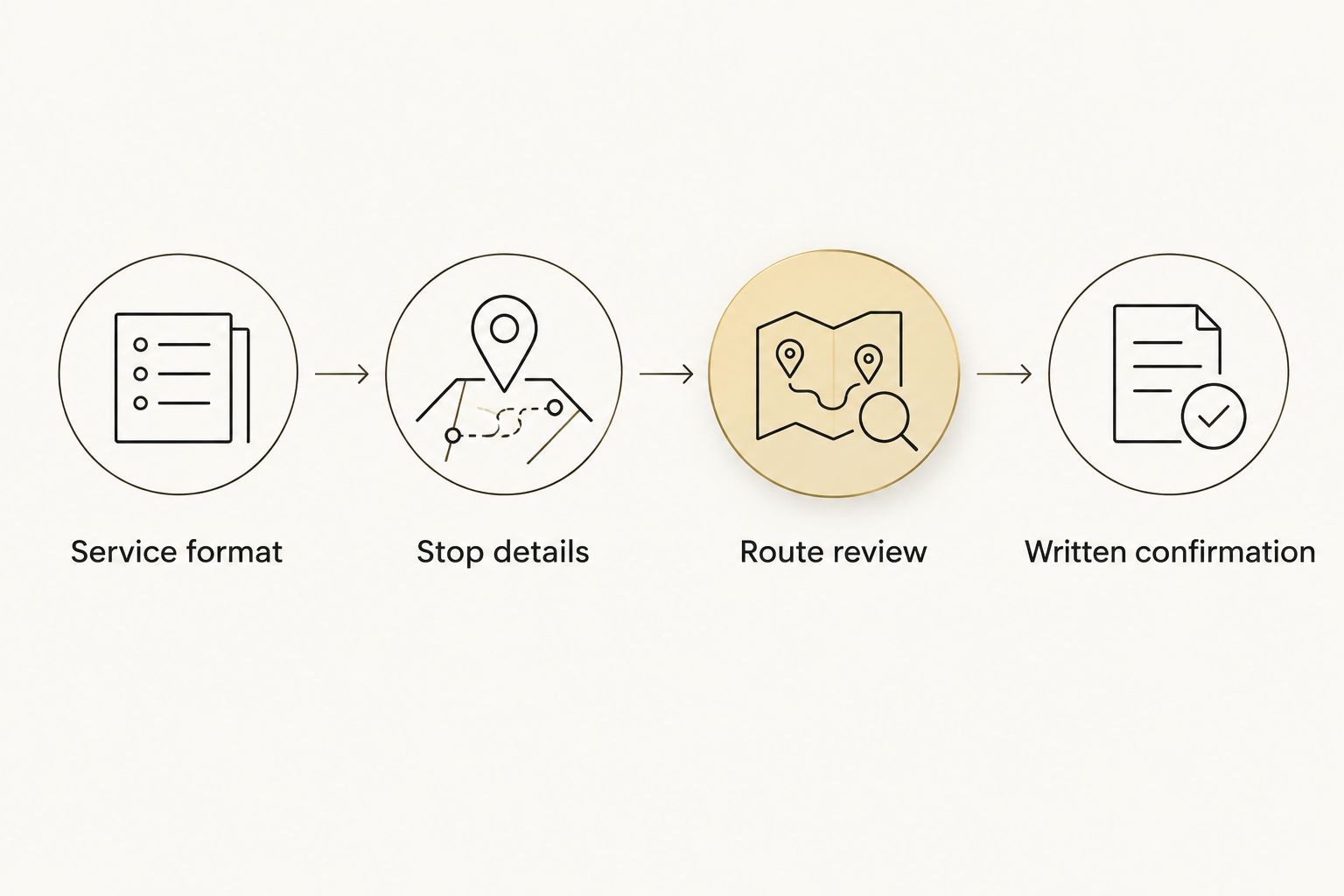
The core sequence is simple: Service format, Stop details, Route review, Written confirmation. Keep those stages in that order. A vehicle preference cannot resolve an incomplete route.
Confirmation and passenger handoff
Send one qualified inquiry
- Put the complete brief into one message. Include dates, service format, preferred vehicle, passengers, bags, initial pickup, all intermediate stops, and final destination.
- State which requirements are fixed. Distinguish a non-negotiable meeting arrival from a preferred departure or vehicle choice.
- Ask for written confirmation of the proposed service scope. Include waiting arrangements, change procedures, vehicle suitability, and any requirements the renter or passengers must meet.
- Request the current terms directly. Fifthaveauto pricing is available on request; use the response for your specific itinerary rather than treating a general example as a booking agreement.
- Review the reply against your brief. Resolve omissions before sharing the itinerary as confirmed.
Expected result: Both sides are referring to the same journey, service format, and scope.
A 2026 itinerary should carry a revision date and a clear status: draft, awaiting confirmation, or confirmed. A polished document is not evidence that every requested stop has been accepted.
Send your roadshow brief
Include your vehicle preference, dates, service format, passenger count, and complete itinerary.
Distribute the working version
- Place the confirmed itinerary in the shared document. Keep previous versions out of the passenger-facing view.
- Send passengers the initial meeting point, departure instruction, traveling contact, and final destination. Keep sensitive meeting material out of transport notes unless it is needed for the journey.
- Agree on the communication channel for operational updates. Confirm how the coordinator should contact the service team during the day.
- Ask the traveling lead to acknowledge the current version. Make sure the person holding the schedule is actually traveling with the group or reachable throughout the itinerary.
Expected result: Passengers know where to be, and the coordinator knows how to communicate a change.
When a roadshow stop changes
Use a controlled update rather than forwarding fragments of a revised meeting invitation. A changed meeting time affects more than the calendar entry.
- Edit the affected stop in the working document and mark the revision time.
- Recheck every later departure and arrival, especially fixed appointments and flight connections.
- Send one change message stating the old instruction, replacement instruction, affected passengers, and requested effective time.
- Obtain acknowledgment from the service team before treating the transport change as agreed.
- Notify the traveling lead of the accepted instruction and remove the superseded version from circulation.
Best for: Roadshows with meeting hosts who revise their schedules during the day. The benefit is a clear record of the accepted plan; the limitation is that editing your document does not itself change the booking.
For a 2026 roadshow with several internal stakeholders, keep approval authority with one named coordinator. Other colleagues can propose changes, but they should not send competing instructions independently.
Troubleshooting
The address is right, but passengers are at the wrong entrance
Call the venue contact and confirm the passenger entrance. Update the stop with a plain-language instruction, then communicate it through the agreed channel. Do not send passengers between entrances while the vehicle follows an older instruction.
A meeting overruns and the next arrival no longer fits
Recalculate the remaining sequence before changing only the next pickup. Ask the next host whether the appointment can move, and ask the service team to confirm the revised transport plan. Do not assume a chauffeur can recover lost meeting time on the road.
The group adds passengers or larger bags
Send the revised passenger and luggage details before departure. Ask the service team to reconfirm suitability rather than relying on the vehicle category name. If the proposed arrangement no longer fits, resolve the transport plan before passengers assemble.
Two colleagues issue conflicting instructions
Pause the competing requests and return authority to the named coordinator. Send a single accepted instruction with its revision time. Ask recipients to disregard the superseded message explicitly.
Customize your workflow
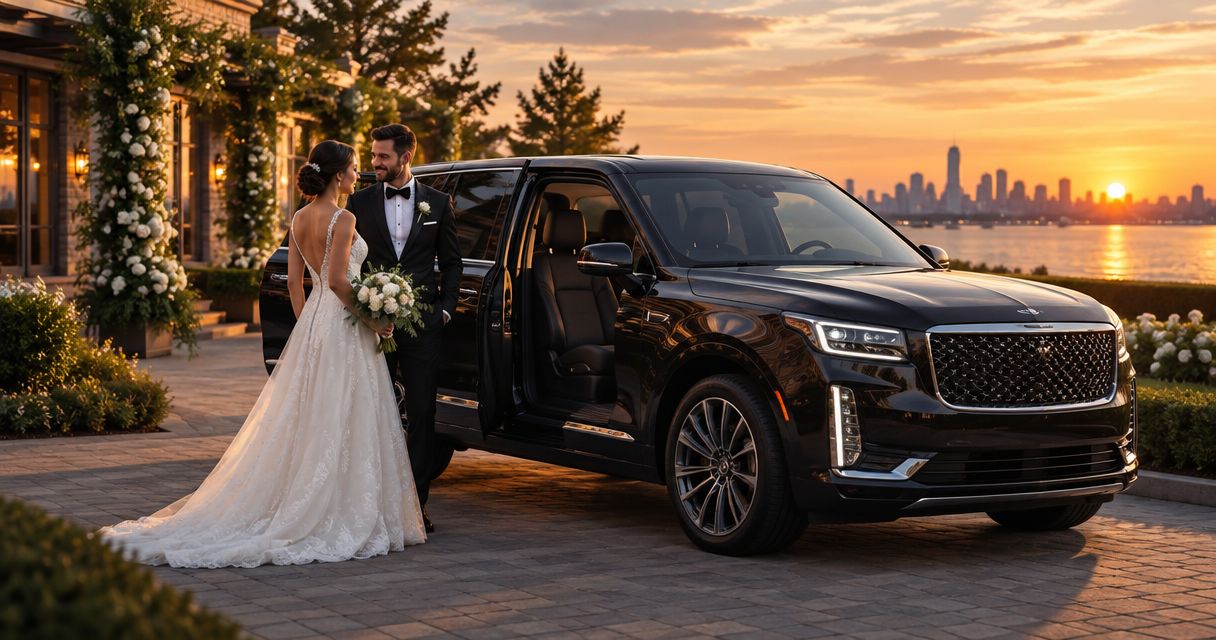
Keep the planning method, but change the details for the journey. Corporate roadshows need meeting contacts and arrival deadlines. Wedding car bookings need ceremony, photography, reception, and passenger-group movements recorded as distinct stops.
For a chauffeured black luxury SUV request, state the requested color, passenger group, and luggage needs in the brief. Ask for confirmation rather than assuming a particular vehicle configuration. For self-drive travel, replace chauffeur handoff instructions with collection, parking, and return responsibilities.
Keep work and personal travel segments separate when a roadshow becomes a weekend trip. Fifthaveauto offers self-drive rentals and chauffeur options from one team, but each segment still needs its own dates, service format, and agreed scope.
FAQ
How do I organize a multi-stop chauffeur itinerary for a roadshow?
Create one shared schedule with every stop, confirmed entrance, required arrival, meeting time, and planned departure. Assign one coordinator to approve changes and obtain written confirmation of the transport scope.
Is a chauffeur better than self-drive for a day of business meetings?
Chauffeured travel is the better fit when nobody in the traveling group should handle driving. Self-drive suits travelers who want to drive and can account for parking, collection, and return responsibilities.
What should I send when requesting a roadshow vehicle?
Send the dates, preferred vehicle, service format, passenger count, luggage details, complete itinerary, and coordinator contact. Identify fixed arrival deadlines and any airport connections.
Can I request a black luxury SUV with a chauffeur?
State a chauffeured black luxury SUV as a requirement in your inquiry and ask the service team to confirm it. Include passengers and luggage so suitability can be checked alongside the vehicle request.
How much time should I leave between roadshow meetings?
Set the interval from the route, departure period, venue entry requirements, and required arrival time. There is no single allowance that fits every journey; ask the service team to review the proposed sequence.
What should I do if a meeting changes during the roadshow?
Update the working itinerary, recheck later stops, and send one clear change request through the agreed channel. Treat the transport revision as accepted only after acknowledgment.
Can I use this workflow for wedding car bookings?
Yes. Record ceremony, photography, reception, and passenger movements as separate stops, with confirmed entrances and departure responsibilities. Keep each passenger group's instructions clear.
One last thing
The meeting end time is not the vehicle departure time. Passengers still need to leave the room, reach the entrance, and assemble. Record both times; that small distinction makes the schedule more usable than another page of general instructions.