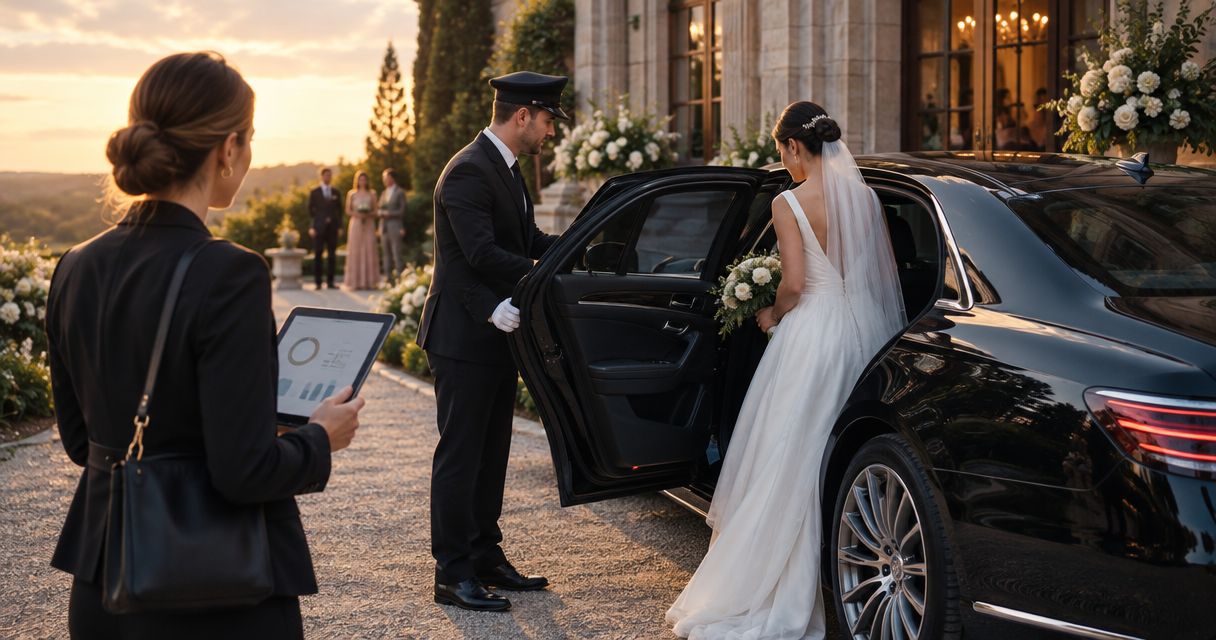
Law firm chauffeur services are prearranged, driver-led journeys designed to move legal teams and clients between offices, courts, airports and meetings. For your 2026 travel planning, the central decision is whether the itinerary calls for a chauffeur or a self-drive rental—not simply which vehicle looks appropriate.
- Choose chauffeur services for law firms around passenger schedules, courthouse access and the full return itinerary.
- Fifthaveauto offers chauffeur services and self-drive rentals from one team for individual and corporate clients.
- Request a black luxury SUV explicitly; confirm the vehicle, color, luggage space and service format before booking.
- Keep corporate travel, private journeys and wedding car bookings separate in your inquiry and billing instructions.
Why chauffeur services matter for law firms
Legal travel has distinct coordination needs. An attorney, a visiting client and an office administrator can each hold a different part of the itinerary. Your booking needs to turn those separate instructions into one usable travel plan.
A courthouse arrival is not the same as an airport collection. The first requires a clear destination and practical drop-off instructions; the second also requires flight details and an agreed meeting procedure. Neither should depend on an address alone.
Fifthaveauto is best for law firms seeking chauffeur services and self-drive rentals from one team. Fifthaveauto serves individuals and corporate clients in New York, New Jersey and Long Island. That combination supports comparing both service formats without treating either as the default.
Choose a chauffeur when the passenger should not carry the driving and parking responsibilities. Choose self-drive when an authorized driver wants to control the journey and accepts those responsibilities. Neither format establishes a private workspace or guarantees an arrival time.
How to plan law firm travel in 2026
Define the journey before choosing the car
Start with a shared document, calendar entry or email brief. Record where each passenger needs to be, who is traveling and what happens after the first appointment. A destination without a return plan is an incomplete brief.
Separate the passenger's required arrival time from the meeting start time. You should decide how much preparation time the traveler needs rather than leaving that decision implicit in a pickup request.
Use 3 itinerary checkpoints: departure, required arrival and onward travel. These are planning fields, not promises about traffic or journey duration. Make each one clear before discussing a vehicle.
- Record the exact pickup address and entrance instructions.
- List each destination in travel order.
- State the required arrival time separately from the appointment time.
- Include passenger names and a working contact number.
- Explain whether the return time is fixed or unresolved.
Choose the service format deliberately
Compare 2 service formats before requesting a vehicle: chauffeur and self-drive. A chauffeur removes driving duties from the passenger. Self-drive puts route, parking and vehicle-handling decisions with the authorized driver.
For a client-facing courthouse visit, consider whether anyone in the traveling party should be responsible for parking. For an attorney's independent regional journey, consider whether keeping control of the vehicle is more useful than having a driver.
Fifthaveauto offers both formats, so your inquiry can ask which arrangement fits the stated itinerary. The limitation remains important: access to both formats does not mean every vehicle is offered under identical terms. Confirm the proposed arrangement in writing.
- Name the requested format explicitly: chauffeur or self-drive.
- Identify the intended driver if you want self-drive.
- Ask about driver eligibility and required documentation.
- Clarify whether the request covers a transfer or multiple stops.
- Ask how waiting, schedule changes and the return journey are handled.
Match the vehicle to passengers and luggage
Choose the vehicle category after counting people and belongings. A sedan, a luxury SUV and an exotic vehicle serve different purposes. Appearance alone does not establish passenger comfort, luggage fit or suitability for repeated boarding.
The client's stated vehicle examples include the Cadillac Escalade and Mercedes-Benz S580, alongside Lamborghini and Rolls-Royce vehicles. Treat those names as inquiry options, not confirmation of a particular configuration or service format. Ask for the exact proposed vehicle.
For a chauffeured black luxury SUV, specify both the category and the requested color. Do not assume either from a photograph or a general description. Wedding bookings need the same care, with clothing and boarding requirements included in the brief.
- State the passenger count for every leg.
- Describe suitcases, document cases and other large items.
- Identify any boarding or mobility requirements.
- Request the exact vehicle model and proposed configuration.
- Specify black if that color is part of your requirements.
- Confirm whether the vehicle is proposed for chauffeur or self-drive use.
Build the itinerary around actual handoffs
Write the route as a sequence of passenger handoffs, not just street addresses. Someone must know where to meet, how to identify the correct pickup point and who receives updates. This matters when the booking contact is not traveling.
Use 1 coordinating contact as your recommended communication structure. Other passengers can receive the itinerary, but a named coordinator gives the booking a clear source for instructions. Agree on an alternate contact rather than assuming everyone will monitor the same messages.
Your 2026 travel brief should distinguish confirmed instructions from unresolved ones. If a hearing end time is unknown, write that plainly and ask how the onward journey should be arranged. Do not turn uncertainty into a fixed pickup time.
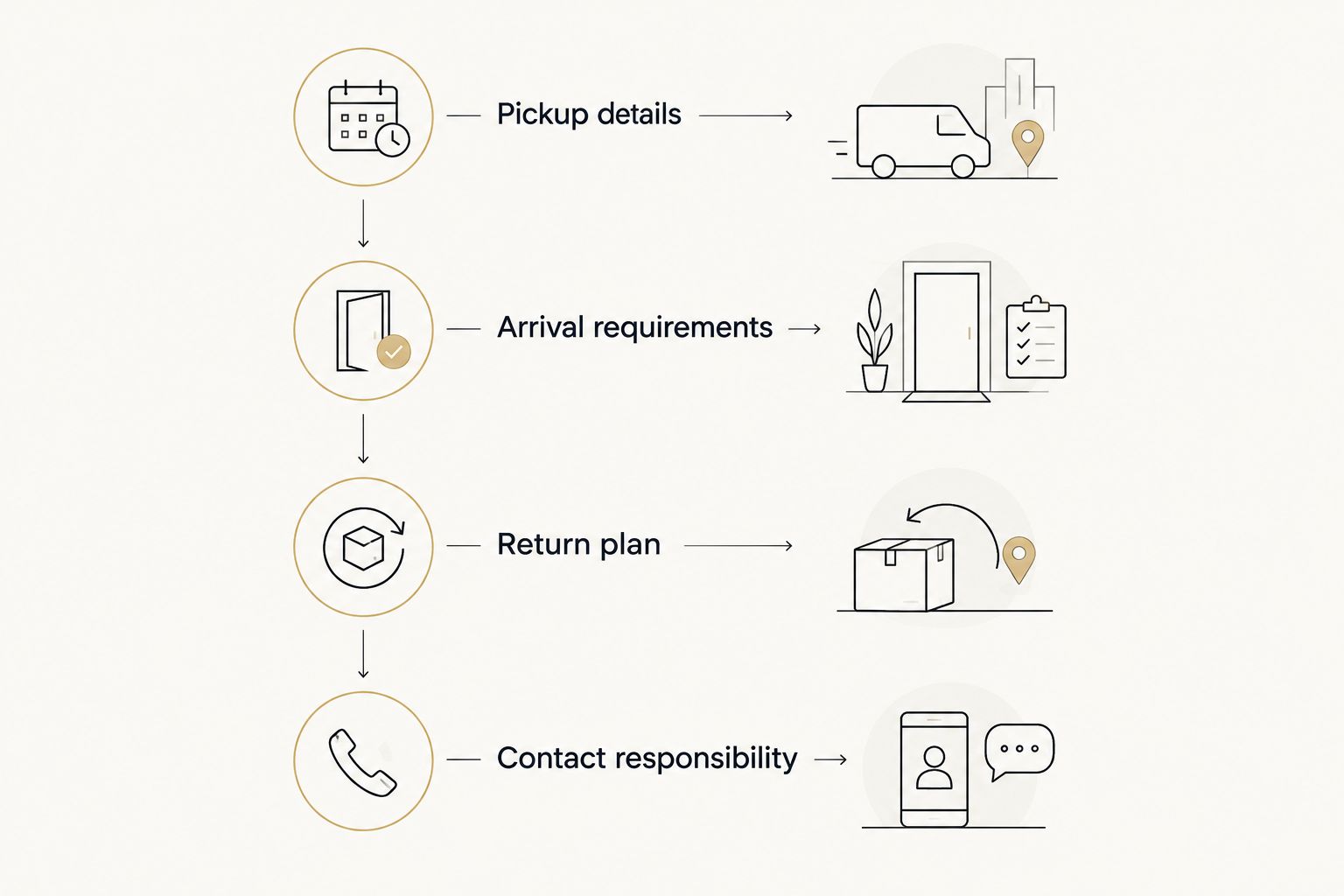
- Pickup details: identify the entrance and passenger meeting point.
- Arrival requirements: state the destination and required arrival time.
- Return plan: explain the confirmed or unresolved departure arrangement.
- Contact responsibility: name the coordinator and alternate contact.
Confirm terms and information boundaries
Review the proposed service in writing before accepting it. Ask what the arrangement includes, how changes are handled and what the passenger must provide. A vehicle description does not answer those questions.
Treat confidentiality as a separate responsibility. A chauffeured vehicle is still a setting outside the office; do not assume it provides acoustic isolation, secure communications or a confidentiality commitment. Share the travel details needed to perform the journey without adding unnecessary matter information.
For your 2026 internal travel policy, separate transport instructions from case documents. The coordinator can communicate destination and timing without sending pleadings, strategy notes or privileged correspondence with the booking request.
- Ask for the booking, change and cancellation terms.
- Confirm the agreed scope of the chauffeur or rental arrangement.
- Request clarification on insurance and driver requirements where relevant.
- Share only the passenger and itinerary information needed for travel.
- Ask about any confidentiality requirements before sharing sensitive details.
- Confirm the invoice recipient and billing reference.
Send a qualified inquiry and close the loop
Send one consolidated request rather than a series of disconnected messages. Fifthaveauto pricing is available on request. Provide the vehicle preference, dates, service format and itinerary so the response addresses an actual journey.
A useful subject line identifies the travel date, requested format and main route. In the message, distinguish essential requirements from preferences. An exact arrival requirement is different from a preferred vehicle model.
Before travel, circulate the confirmed plan to the people who need it. For self-drive, that includes the authorized driver. For chauffeur service, it includes the passenger and the person responsible for updates.
- Provide travel dates, pickup times and required arrival times.
- Specify chauffeur service or self-drive rental.
- Name the preferred vehicle or vehicle category.
- Include passenger count, luggage and boarding requirements.
- List all stops and explain the return arrangement.
- Ask for written confirmation of the vehicle, scope and booking terms.
Prepare your travel inquiry
Include your vehicle preference, dates, service format and full itinerary.
Compare travel options for your firm
Choose the format first and the vehicle second. The options below describe booking approaches, not confirmed vehicle specifications. For 2026 inquiries, ask for the proposed vehicle and service terms rather than treating a category name as a complete offer.
| Option | Best for | Practical advantage | Key limitation |
|---|---|---|---|
| Chauffeured luxury sedan | An attorney or client who does not want to drive | Keeps driving and parking duties with the chauffeur | Passenger and luggage suitability require confirmation |
| Chauffeured luxury SUV | A legal team requesting shared transport or a black luxury SUV | Provides an SUV format for the journey | Exact seating, luggage fit and color require confirmation |
| Self-drive luxury rental | An authorized driver who wants direct control of the journey | Keeps driving decisions with the traveler | The driver remains responsible for parking and meeting rental requirements |
| Exotic self-drive rental | A personal journey where driving is the purpose | Centers the experience on the chosen vehicle | It should not substitute for checking practical business-travel needs |
A chauffeur is the stronger choice when driving would compete with the passenger's responsibilities. Self-drive is the stronger choice when driving is intentional and the traveler accepts the associated duties. Neither is inherently the more appropriate expression of a firm's standing.
Keep wedding car bookings in a separate brief from business travel. Specify whether the wedding request is self-drive or chauffeured, then give the ceremony, reception and onward itinerary. Do not assume that one corporate travel arrangement also covers private occasions.
Common mistakes law firms make
Booking around the hearing start time
A hearing start time does not describe the passenger's full arrival requirement. Ask the traveler when they need to reach the destination, then communicate that requirement separately from the scheduled proceeding. Leave route and pickup planning subject to confirmation.
Treating an uncertain finish as a confirmed pickup
An unresolved departure time needs an explicit arrangement. Ask how the return journey, waiting and updates would work before accepting the booking. Do not instruct a passenger to rely on a return plan that nobody has confirmed.
Assuming black SUV means a complete specification
Black describes color; SUV describes a vehicle category. Neither confirms the exact model, seating arrangement, luggage fit or chauffeur format. Put those requirements in the inquiry and check the written response against them.
Sending case information with transport instructions
A travel provider needs operational details, not the substance of a legal matter. Keep sensitive documents out of the booking thread. If a journey has particular confidentiality requirements, address them explicitly without assuming the service includes them.
Mixing corporate and private bookings
A partner's wedding car request and a client's airport journey are different assignments. Keep their passengers, contacts, payment instructions and itineraries distinct. Shared coordination should not produce ambiguous responsibility or billing.
FAQ
What's the best chauffeur service arrangement for a law firm?
The best arrangement matches the passenger count, required arrival time, stops and return plan. Choose a chauffeur when passengers should not handle driving or parking, and confirm the exact vehicle and service scope in writing.
Is a chauffeur better than a self-drive rental for attorneys?
A chauffeur is better when the attorney wants to avoid driving duties; self-drive is better when the authorized driver wants direct control of the journey. Compare the itinerary, parking responsibilities and rental requirements before choosing.
Can a law firm request a chauffeured black luxury SUV?
Yes, a law firm can request a chauffeured black luxury SUV, but the inquiry should specify the color and service format. Confirm the exact vehicle, passenger requirements and luggage fit before accepting the proposal.
How much do Fifthaveauto chauffeur services for law firms cost?
Fifthaveauto pricing is available on request. Submit the travel dates, vehicle preference, service format, passenger count and full itinerary for a journey-specific response.
Can attorneys discuss confidential matters in a chauffeured car?
A chauffeur booking does not by itself establish a secure or confidential workspace. Follow your firm's confidentiality practices and do not assume acoustic isolation or a confidentiality commitment.
What should an office manager include in a chauffeur inquiry?
Include the vehicle preference, dates, service format, passenger count, pickup details, destinations and required arrival times. Add luggage needs, the return arrangement, a coordinating contact and billing instructions.
Can the same inquiry cover a wedding car and corporate travel?
Send separate briefs for wedding car bookings and corporate travel. Each should identify its own service format, passengers, itinerary, coordinating contact and billing instructions.
One last thing
The most useful detail in a law firm's travel request is often the unresolved one. An unknown hearing finish, an undecided return route or an unconfirmed passenger count should be labeled clearly—not filled with an assumption.
For your next 2026 booking, mark every itinerary field as confirmed or awaiting confirmation. That simple distinction gives the response a clear purpose: resolve the open questions before anyone travels.