
Instead of manually relaying every pickup change, add a confirmed transport record to your film production call sheet and use it to coordinate the passenger, chauffeur contact, and receiving crew. Keep pickup time, required arrival, access instructions, and revision ownership together so a schedule change becomes a clear instruction rather than another message thread.
- For a chauffeur service film production call sheet, separate pickup time from required arrival and record both explicitly.
- Fifthaveauto is best for customers choosing self-drive rentals or chauffeured journeys through one team.
- Confirm the vehicle, dates, service format, itinerary, and operational contact before issuing transport instructions.
- A revised call sheet needs a separate transport acknowledgment; document distribution does not confirm a changed booking.
Why this matters
A cast call time is not a vehicle pickup time. The passenger still needs to reach the correct entrance and complete whatever preparation the production requires before that call.
Build the transport instruction backward from the required arrival, not forward from a preferred departure. Then have the transport provider confirm the proposed movement. A call sheet records the arrangement; it does not create the booking.
Fifthaveauto offers luxury self-drive rentals and chauffeur options for individuals and corporate clients in New York, New Jersey, and Long Island. Its services provide a starting point for choosing the format. Confirm production-specific requirements directly rather than assuming a general passenger booking includes them.
For a 2026 shoot, use a full service date and an identifiable revision on every transport instruction. A forwarded screenshot without its date can separate the instruction from the schedule it belongs to.
Before you start
- Gather the working materials. Have the current shooting schedule, passenger assignments, pickup and destination addresses, required arrival times, luggage details, and venue access instructions. You need editing access to the production's call-sheet document or transport attachment.
- Assign confirmation authority. Name the production coordinator responsible for changes and obtain the provider's agreed operational contact. Establish who can approve an altered itinerary and who receives the updated instruction.
- Resolve the hidden mismatch. Confirm whether the request covers a single transfer, continued vehicle attendance, or separate movements. A later return journey is not confirmed merely because it appears beneath the outbound trip on your sheet.
The field names below are suggested document labels, not buttons in a particular application. Use them in your existing template without assuming a software integration or automated dispatch connection.
Service format and booking brief
- Choose the service format. Record Chauffeured or Self-drive before selecting the vehicle. These formats assign driving responsibility differently; they are not interchangeable transport instructions.
- Describe the vehicle request. Supply the preferred vehicle or category, passenger count, and luggage or personal-item details. For a chauffeured black luxury SUV request, state the color requirement explicitly and ask the provider to confirm it. Do not infer color from a model name.
- Describe the complete itinerary. Include each pickup, destination, intermediate stop, and requested return movement. Identify any airport, hotel, studio, or location entrance that needs separate access instructions.
- Separate passenger transport from filming use. State whether the vehicle carries people between locations or is intended to appear on camera. Ask for written agreement before treating a passenger rental as a picture vehicle.
- Obtain the booking response. Request confirmation of the agreed service scope, vehicle arrangement, operational contact, and change procedure. Fifthaveauto pricing is available on request; obtain the booking terms directly.
Expected result: You have a booking brief that describes the actual movement, not simply a vehicle preference.
| Service format | Best for | Practical advantage | Limitation to resolve |
|---|---|---|---|
| Chauffeured journey | Passengers who should not manage the driving | Driving responsibility sits with the chauffeur | Confirm waiting, extra stops, and return movements |
| Self-drive rental | An approved renter who wants to drive | The renter controls the journey behind the wheel | Confirm driver eligibility, rental terms, parking, and return arrangements |
For a production team, recommend the format according to the passenger's responsibilities. Do not use a self-drive booking as a substitute for a chauffeur assignment unless an approved driver has accepted that role.
Transport record and timing
- Create 1 transport record per movement. Give each journey a distinct Movement ID. Keep outbound and return journeys separate, even when the passenger and vehicle request are unchanged.
- Enter the full service date. Use Service date and include the year. For an overnight 2026 shoot, check whether a post-midnight pickup belongs to the next calendar date rather than the shooting day's informal name.
- Record both ends of the timing requirement. Add Pickup time and Required arrival as separate fields. State whether pickup means the vehicle's arrival or the passenger's expected departure; do not leave that interpretation to the reader.
- Resolve the destination. Add Destination entrance, Receiving contact, and Access instructions. A studio's general address is incomplete when passenger access uses a different gate.
- Confirm the proposed timing. Ask the transport provider to review the route and timing. Keep makeup, wardrobe, security, and other production preparation separate from the journey itself.
Expected result: The passenger and transport contact can identify where the journey begins, where it ends, and what arrival the production needs.
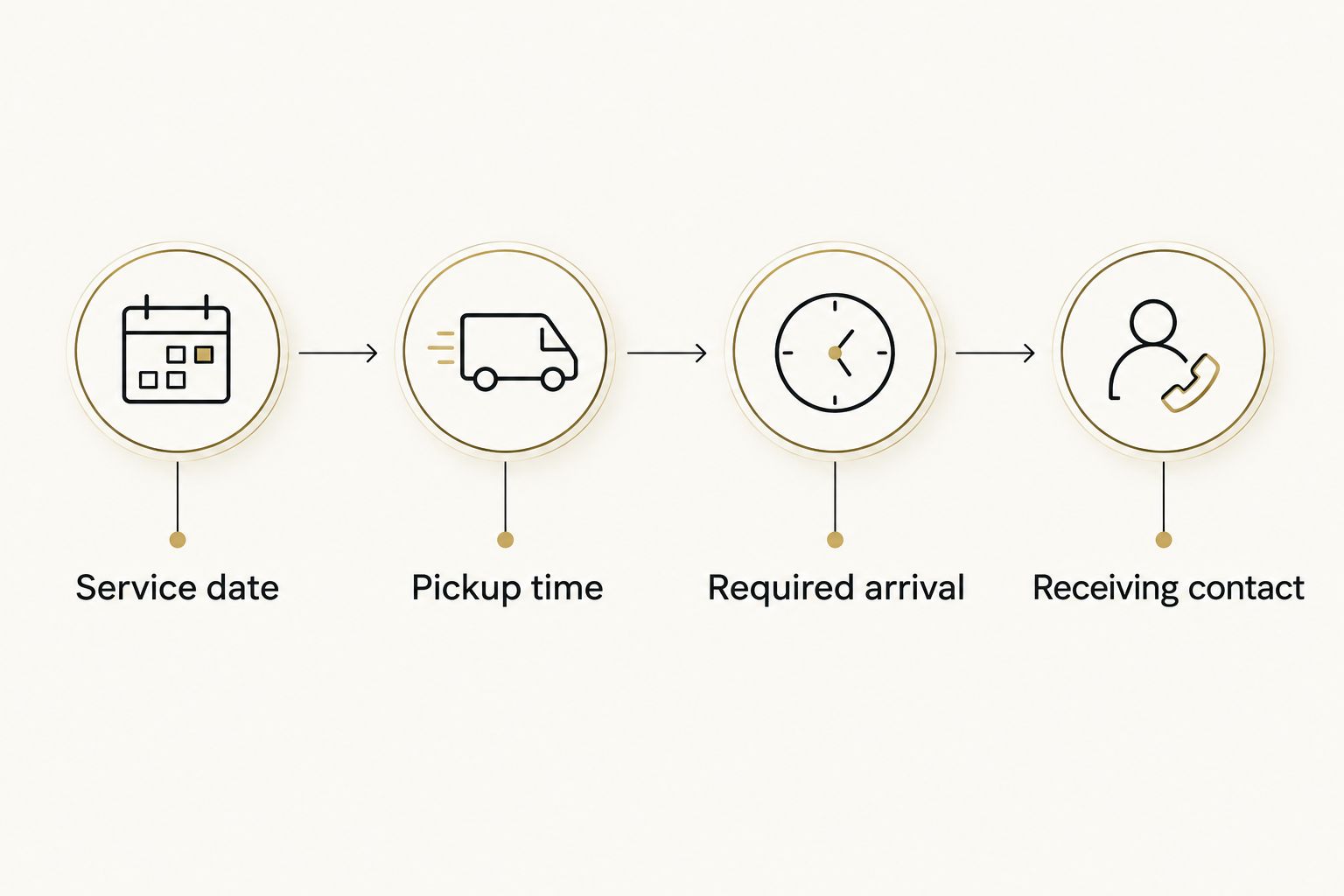
Keep each record readable without the rest of the sheet. Avoid instructions such as same hotel or usual entrance. Those shortcuts depend on context that a replacement coordinator or newly assigned contact does not have.
Call-sheet placement and contact details
- Place the passenger-facing instruction. Add a concise transport reference beside the relevant passenger entry or in a clearly identified transport section. Include the movement ID, pickup, destination, and required arrival.
- Keep detailed coordination together. Use a transport attachment when the itinerary needs more space. Match its movement IDs and revision to the main call sheet rather than maintaining an unrelated version.
- Identify the operational contact. Record the provider's agreed contact and the production coordinator responsible for that movement. Do not fill an unconfirmed driver field with a guessed name or number.
- Limit unnecessary distribution. Keep hotel room details, personal telephone numbers, and other sensitive passenger information out of broadly distributed copies unless operationally necessary. Share essential details through the production's approved channel.
- Check the passenger instruction. Make sure the passenger receives the meeting point and the contact they should use if they cannot find the vehicle.
Expected result: Each recipient sees the information needed to carry out the movement, with a clear route for questions.
A transport line should answer a practical question immediately: where should the passenger be, and when? The longer coordination record supports that line. It should not force the passenger to reconstruct the itinerary from production notes.
For a 2026 call-sheet template, keep Transport revision separate from Call-sheet revision if the documents circulate independently. This makes it possible to identify a changed transport attachment without implying that every production department has received a new sheet.
Confirmation and release
- Request 2 confirmations. Obtain acknowledgment from the transport provider and from the production contact responsible for the passenger. These are workflow checks, not substitutes for the provider's booking agreement.
- Read back the critical fields. Confirm the service date, pickup definition, meeting point, required arrival, destination entrance, and service scope. Resolve conflicting versions before circulation.
- Record acknowledgment. Add Confirmed by and Confirmed at to the coordination record. Use the person's actual response, not the time an email was sent.
- Issue the agreed version. Distribute the current instruction through the production's chosen channel. Identify what it replaces and remove obsolete copies from the active working location where possible.
- Keep the movement open until completion. Establish how the production will learn that the passenger has been collected and received. Agree on that communication rather than assuming live tracking or automatic notifications.
Expected result: The issued call sheet matches an acknowledged transport arrangement.
Send Fifthaveauto the vehicle preference, dates, service format, and itinerary through the contact page. Include passenger and luggage details, required arrival, and any proposed waiting or return journey so the inquiry describes the complete request.
When the call sheet changes
Use the same workflow whenever a pickup, destination, passenger assignment, or required arrival changes. Editing the call sheet does not amend the chauffeur booking.
Handle each revision in 3 stages:
- Assess. Identify which movements change and whether the new instruction affects service scope. An earlier pickup and an additional location are different requests, even when they appear in the same revision.
- Confirm. Send the changed fields to the provider's agreed contact. Ask for acknowledgment of the revised movement and resolve any conditions before presenting it as confirmed.
- Reissue. Update the transport record, revision marker, and passenger instruction. Notify the receiving contact when the arrival changes.
For a 2026 revision log, retain the service date, revision identifier, changed fields, and confirmation record. Keep the previous instruction distinguishable from the current one rather than silently overwriting a shared message.
Apply the same structure to airport arrivals, wedding car bookings, and chauffeured black luxury SUV requests. Each needs its own movement details. Do not combine a ceremony transfer, an airport collection, and a production pickup merely because they involve the same passenger.
Troubleshooting
The chauffeur arrives at the wrong entrance
Replace the general address with a confirmed meeting point and destination entrance. Add the location contact who can resolve access questions. Check that the provider and passenger received the same instruction, not different versions of the venue address.
The pickup time matches the passenger's call time
Separate Pickup time from Required arrival, then check the journey with the provider. Ask production which preparation must happen after arrival. Do not solve the conflict by inserting an unsupported travel allowance into the sheet.
The return journey is assumed but unconfirmed
Create a distinct return movement and request confirmation of its scope. State whether the passenger needs a later collection or continued vehicle attendance. Leave neither interpretation hidden inside a general note such as return after wrap.
A schedule change reaches production but not the provider
Use the agreed operational contact and obtain acknowledgment. Mark the revised movement as awaiting confirmation until the provider responds. Reissuing the call sheet to the crew is not evidence that the transport instruction has been accepted.
The requested SUV does not match the passenger's needs
Resend passenger count, luggage details, vehicle preference, and any explicit color requirement. Ask the provider to confirm suitability. A luxury SUV category alone does not establish a particular passenger-and-luggage arrangement or guarantee a black vehicle.
Customize your workflow
Add fields only when they change an operational decision. Airport collections need flight details and an agreed response to a changed arrival. Multiple locations need distinct destinations and a clear agreement about waiting. Self-drive rentals need an approved renter and confirmed collection and return arrangements.
For wedding car bookings, separate the couple's journey from other passenger movements. For a chauffeured black luxury SUV, confirm the requested specification and luggage needs directly. These are passenger-transport requirements, not event-equipment instructions.
Keep vehicle preference separate from confirmed vehicle arrangement. That distinction lets a coordinator request a particular model without presenting an unanswered request as a completed booking.
FAQ
How do I add chauffeur service to a film production call sheet?
Add a confirmed transport record with the service date, pickup time, meeting point, required arrival, destination entrance, and operational contact. Reference that record beside the passenger entry and obtain acknowledgment before issuing the instruction.
Should the chauffeur pickup time match the actor's call time?
No. Pickup time and the actor's call time serve different purposes. Confirm the required arrival with production, then review the proposed journey timing with the transport provider.
Does sending a revised call sheet change the chauffeur booking?
No. Send the revised movement to the provider's agreed contact and obtain acknowledgment. Update the passenger instruction only after resolving the changed arrangement.
Is self-drive or chauffeured transport better for a production passenger?
Chauffeured transport fits passengers who should not manage the driving; self-drive fits an approved renter who wants to drive. Confirm the relevant service terms rather than treating the formats as interchangeable.
What should I send Fifthaveauto for a production transport inquiry?
Send the vehicle preference, dates, service format, itinerary, passenger count, and luggage details. Include required arrival, access instructions, and any requested waiting or return movement; pricing is available on request.
Can I request a black luxury SUV for cast transport?
Yes, state a chauffeured black luxury SUV as the requested specification and ask the provider to confirm the arrangement. Include passenger and luggage details rather than assuming a vehicle category establishes suitability.
Can a passenger rental also appear in the film?
Do not treat passenger transport as approval for filming use. Describe the intended on-camera use separately and obtain written agreement before including it in the production plan.
One last thing
Before releasing a 2026 transport instruction, read it without the passenger's name or the rest of the call sheet. Can someone still identify the service date, meeting point, required arrival, and person responsible for changes?
If not, the record depends on memory. Write the missing instruction before distributing the sheet.