Instead of manually reconfirming every showing, passenger detail, and pickup change, build one property-tour itinerary and have the transport provider confirm the driving plan against it. For 2026 tours, settle property access first, then choose a chauffeured vehicle or self-drive rental around the confirmed appointments.
- Chauffeured property tours real estate agents arrange should start with confirmed appointments, not a vehicle reservation.
- Fifth Ave Auto Group suits agents comparing luxury self-drive rentals and chauffeur options from one team.
- Keep property access, driving instructions, and passenger requirements in one current itinerary.
- Confirm the service format, vehicle request, dates, and route before accepting the booking terms.
Why this matters
A property tour joins two separate schedules: access to each listing and transport between addresses. A transport confirmation does not confirm a showing. A showing confirmation does not establish where the vehicle can meet your clients.
Fifth Ave Auto Group is best for agents comparing luxury self-drive rentals and chauffeured property tours with one team. Its stated service area includes New York, New Jersey, and Long Island. Review the luxury rental and chauffeur services before preparing your inquiry.
Keep the operating brief separate from your sales presentation. The driver needs entrances, timing, and contact instructions—not your buyer's budget or negotiating position.
Before you start
- Secure appointment access. Gather confirmed showing windows, the listing representative's contact details, entry instructions, and any building check-in requirements. Keep tentative appointments visibly separate.
- Establish passenger and vehicle requirements. Record everyone traveling, luggage or presentation materials, mobility requirements, and the preferred service format. For a self-drive rental, ask what driver documentation and rental conditions apply.
- Identify the hidden handoff problem. A listing address is not necessarily the vehicle pickup point. Confirm the passenger entrance and a lawful meeting arrangement before treating a stop as ready.
You need access to your calendar and a shareable itinerary document. No software integration is required. The field names below are suggested labels for your own document, not buttons in a booking platform.
Tour brief
Define the booking request
- Create 4 required fields: Vehicle, Dates, Service format, and Itinerary. Put these at the top of the document so the transport provider can assess the request without searching through messages.
- Specify the vehicle request without treating it as confirmed. State whether you want a luxury sedan, a luxury SUV, or another vehicle type. If you request a named model, ask the provider to confirm that model in writing.
- Write the full dates. Use an unambiguous format such as September 18, 2026. Add pickup time, starting address, expected finish, and final destination. Do not send only “Friday afternoon.”
- Choose who drives. State either chauffeured service or self-drive rental. If you are comparing both, request separate terms rather than leaving the format undecided.
- List the traveling party. Include the agent if the agent rides with the buyers. Describe luggage, samples, or other items that need space, and ask the provider to confirm the proposed arrangement.
Expected result: A provider can identify the vehicle request, dates, service format, and route from the opening brief. No essential detail is buried in a later email.
Compare the service formats
Neither format removes the need for confirmed showing access. The distinction is who carries the driving responsibility during the tour.
| Service format | Best for | Practical advantage | Limitation to resolve |
|---|---|---|---|
| Chauffeured luxury sedan | A smaller traveling party prioritizing conversation between showings | The agent does not drive between properties | Confirm passenger and luggage fit for the proposed vehicle |
| Chauffeured luxury SUV | A group needing an SUV layout for the tour | The agent can stay with the clients between appointments | Confirm seating, belongings, and pickup access; do not assume every SUV suits the same load |
| Luxury self-drive rental | An agent or client who wants to handle the driving | The renter controls the driving portion of the itinerary | A designated driver must also manage parking, navigation, and the rental conditions |
For chauffeured black luxury SUVs, make black an explicit request and ask for written confirmation. A vehicle category alone does not confirm its color, configuration, or suitability for your party.
Fifth Ave Auto Group offers luxury self-drive rentals and chauffeur options from one team. That distinction makes it relevant when your clients have not yet decided whether they want to drive. Choose the format around the day's responsibilities, not the vehicle photograph.
Route and appointment plan
Build the stop record
- Create one record per property. Use the labels Property, Showing window, Entrance, Access contact, and Next pickup. Keep apartment or unit identifiers with the property record rather than inside a general route note.
- Mark access status. Label each appointment confirmed or tentative. Do not present a seller's proposed window as a final appointment.
- Order the confirmed stops. Start with fixed access windows, then assess the route between them. Geography matters, but a nearby property is not a useful first stop if entry is scheduled later.
- Separate viewing time from travel time. Include building entry, elevators, walking back to the vehicle, and passenger boarding in your assessment. Do not treat a map's driving estimate as the full gap between appointments.
- Define the final destination. State whether clients finish at their hotel, office, residence, airport, or another agreed address. The last showing is not automatically the end of the transport requirement.
Expected result: Each stop has a confirmed purpose, a usable entrance, an access contact, and a defined onward movement. Any unresolved stop remains visibly tentative.
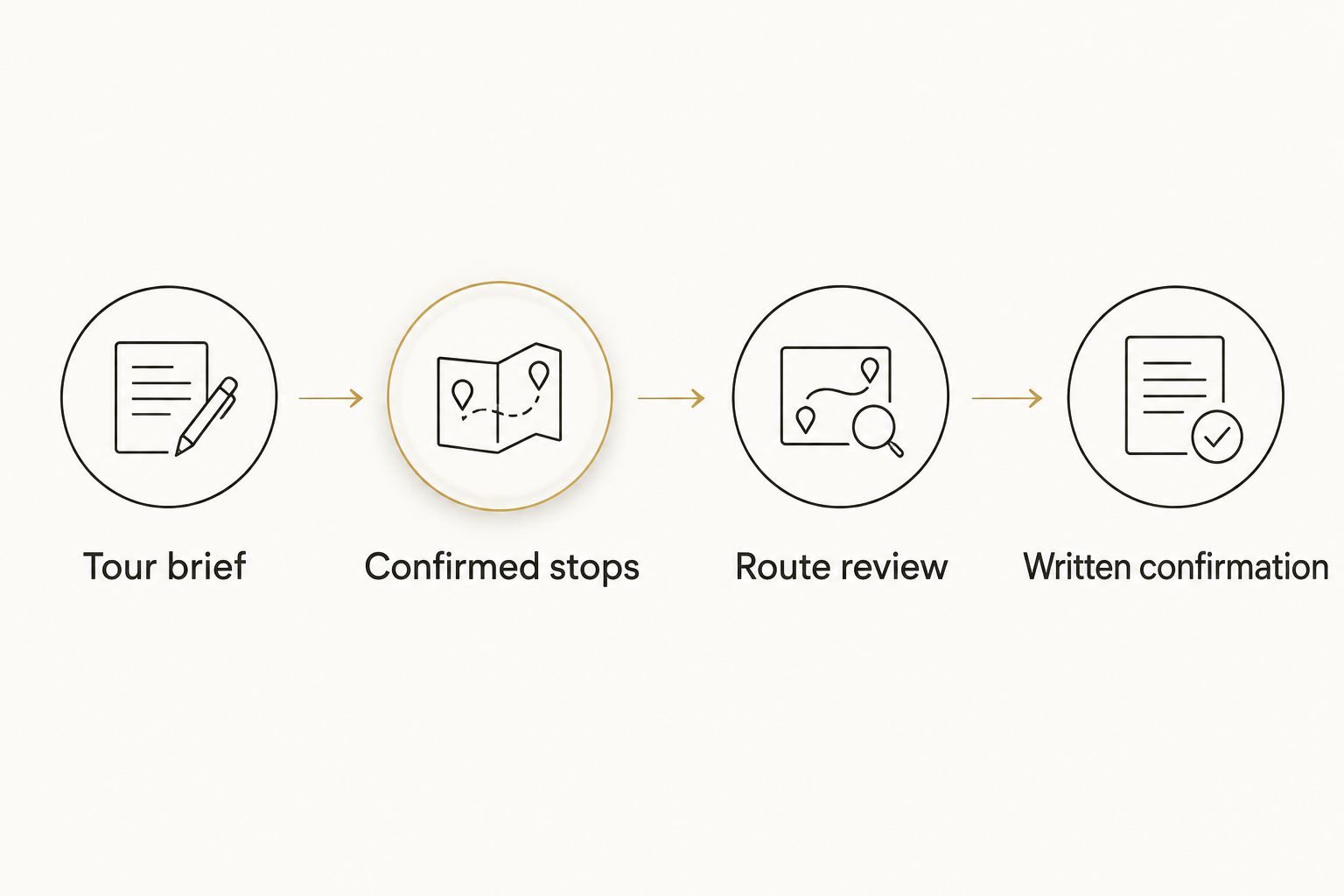
The route is ready to send when its sequence is clear: Tour brief, Confirmed stops, Route review, Written confirmation. Keep that order even when the itinerary is short.
Review timing before confirmation
Use 3 checkpoints: Property access, Passenger handoff, and Final destination. Check each against the calendar rather than reviewing only the driving route.
- Property access: Does the appointment allow the group to enter at the planned arrival time? Who answers if entry instructions fail?
- Passenger handoff: Where does everyone leave and rejoin the vehicle? Who tells the driver when the group is ready?
- Final destination: Does the requested finish include the full journey after the last showing?
For a 2026 tour that crosses between New York and New Jersey, include both sides of the route in the original request. Ask the provider to confirm the proposed journey and applicable terms. Do not assume an agreed city pickup covers every later route change.
Provider confirmation and client handoff
Close the open questions
- Send one consolidated inquiry. Include the tour brief, stop records, passenger requirements, and unresolved questions. Identify who can approve changes on the agent's side.
- Ask which booking structure fits. Explain whether you need the vehicle between showings or only for specified journeys. Ask how waiting, additional stops, schedule changes, and an extended finish are handled.
- Confirm the proposed vehicle and service format. Check the written response against your request. A suggested alternative needs review, not silent acceptance.
- Read the booking conditions. Confirm cancellation terms, changes, passenger arrangements, and any documentation required for self-drive rentals before accepting.
- Issue the client itinerary. Share the agreed pickup details, showing sequence, contact arrangement, and final destination. Keep seller access codes and unnecessary client information out of broadly shared copies.
Expected result: The agent, clients, and transport provider work from the same agreed sequence. Property confirmations remain identifiable as separate from transport confirmations.
Submit the qualified brief through the contact page. Fifth Ave Auto Group can then receive the vehicle request, dates, service format, and itinerary together rather than as disconnected messages.
Send your property-tour brief
Include your vehicle request, dates, service format, passenger details, and proposed itinerary.
When a showing changes
Use the same workflow whenever a listing is added, removed, or rescheduled. A calendar edit alone is not confirmation that transport has changed.
Keep 2 versions: Working draft and Confirmed itinerary. Edit the draft first; replace the confirmed itinerary only after affected parties acknowledge the revision.
- Identify the changed appointment and its effect on later stops.
- Recheck property access before adjusting the driving sequence.
- Send the revised route and finish to the transport provider.
- Obtain confirmation of the revised service arrangement and terms.
- Replace the previous client itinerary and clearly mark it as superseded.
Use a dated document name, such as Property tour — September 18, 2026 — Confirmed itinerary. Put the revision time inside the document. Avoid distributing several attachments with indistinguishable names.
Best for repeat tours: Reuse the blank structure, not the previous client's completed itinerary. This preserves useful fields without carrying forward private details or outdated entrances.
Troubleshooting
The showing runs beyond its planned window
Tell the transport provider and the next listing contact as soon as the delay is clear. Ask what changes the provider can confirm, then decide which later appointments remain workable. Do not promise clients an unchanged finish before checking it.
The vehicle cannot meet at the listing entrance
Confirm a lawful alternative meeting point with the driver and share it with everyone traveling. Update the stop record. Do not leave clients following the original entrance instructions while the vehicle waits elsewhere.
Another buyer or adviser joins the tour
Reconfirm the full passenger and belongings requirement before the additional person travels. Ask whether the proposed vehicle still fits the party. A new passenger is a booking change, not merely a calendar update.
The route contains an unconfirmed property
Keep the stop tentative and avoid building fixed promises around it. Ask the listing contact for confirmation, then have the transport provider review any resulting route change. Remove the stop from the client-facing confirmed sequence if access remains unresolved.
The driver and clients have different itineraries
Stop circulating edits through separate message threads. Send one current version to the agreed contacts and ask them to acknowledge it. Identify which previous document it replaces.
Customize your workflow
For recurring 2026 buyer visits, save a blank template with the same required fields and checkpoints. Add optional sections for airport arrivals, luggage, or an agent joining midway. Only include sections relevant to that journey.
A wedding car booking uses similar scheduling discipline: confirmed venues, passenger movements, pickup points, and a final destination. Keep it separate from a property tour, with its own inquiry and service confirmation. Do not assume one booking's vehicle or conditions carry over to another occasion.
For self-drive tours, add a driver handoff and return checklist. For chauffeured tours, identify who communicates changes while the agent is inside a property. These are different responsibilities and deserve different instructions.
FAQ
How do real estate agents arrange chauffeured property tours?
Real estate agents arrange chauffeured property tours by confirming showing access, building a stop-by-stop itinerary, and requesting transport against that plan. The inquiry should identify the vehicle request, dates, passengers, service format, pickup, and final destination.
Is a chauffeured vehicle better than a self-drive rental for property viewings?
A chauffeured vehicle is the better fit when the agent wants to stay with clients rather than drive between showings. A self-drive rental suits a designated driver who wants to handle the journey and accepts responsibility for parking, navigation, and rental requirements.
What should I send Fifth Ave Auto Group for a property-tour inquiry?
Send Fifth Ave Auto Group your vehicle request, dates, service format, passenger details, and proposed itinerary. Include pickup and final addresses, showing windows, belongings, and any unresolved route questions.
Can I request a black luxury SUV for a real estate tour?
You can include a black luxury SUV in your vehicle request, but the provider must confirm the specific proposal. Ask about passenger fit, belongings, color, and the planned pickup arrangements rather than assuming them from the category.
Should I book hourly chauffeur service or separate transfers?
Choose the structure after explaining whether you need the vehicle between showings or only for defined journeys. Ask the provider to confirm how waiting, additional stops, changes, and the final destination are handled.
What happens if a seller changes the appointment time?
Reconfirm property access and send the revised itinerary to the transport provider before treating the change as agreed. Update the client itinerary only after the affected arrangements are confirmed.
Can the same planning checklist help with wedding car bookings?
The same core checklist helps organize wedding car bookings: vehicle request, dates, service format, passenger details, and itinerary. Use a separate booking brief and obtain fresh confirmation for the wedding's venues and passenger movements.
One last thing
The most useful address in your itinerary is sometimes the pickup address, not the property address. Check both before your next 2026 tour. A precise passenger meeting point closes the gap between leaving a showing and starting the next journey.